The Great Transition
A Field Guide to the Universal Chaos of the Next Decade

Part 1 (2025–2027): The Era of Cognitive Dissonance
Honestly, I don’t think the human brain is wired for what’s coming over the next 36 months. We are about to enter a period of profound cognitive dissonance that will be felt in every corner of the globe. Forget the word “progress.” Progress implies a steady, manageable climb up a hill. What we are facing is going to feel more like a collective fever dream. The tweet I quoted up top is spot on: we’re about to drown in headlines that sound straight out of a sci-fi novel.
It won’t just be abstract science. You’ll wake up on a Tuesday and read that an AI model just cracked the code for a universal cancer vaccine. By Friday, a lab on the other side of the world might announce they’ve stabilized a room-temperature superconductor. It’s going to be relentless. Miracle after miracle, week after week, until we are totally numb to the news.
But here’s the trap: You won’t be able to touch any of it.
This is the first phase of the disaster: The “Paperware Panic.” We are going to stare at incredible breakthroughs that exist in a lab but are currently illegal or impossible to give to humans. This is because we are walking straight into a phenomenon known as Martec’s Law. It’s a simple but terrifying concept: Technology changes exponentially, but organizations change logarithmically (slowly).
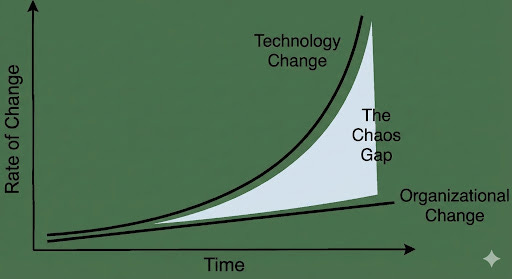
The gap between those two curves is where the chaos lives. Global regulatory bodies—whether for drugs, aviation, or finance—are linear. They move at the speed of bureaucracy. Technology is a vertical line straight up. When an exponential force slams into a linear bureaucracy, the system doesn’t adapt; it breaks.
We are seeing a real-time example of Eroom’s Law (Moore’s Law spelled backward), which observes that despite better technology, drug discovery has actually become slower and more expensive because of increased regulatory friction. If a loved one gets sick in 2026, and you know an AI drug exists that works in simulations, but the regulators demand another seven years of human trials, what happens? Rage. Pure, unadulterated rage.
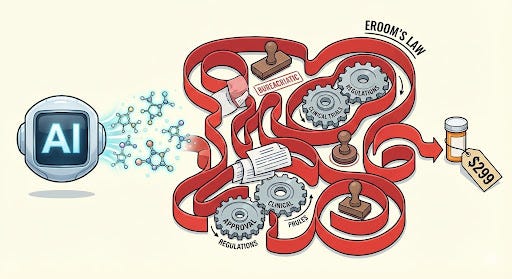
We won’t see abundance yet. We’re going to see agonizing vaporware. We will see the rise of “medical tourism” to offshore havens that deregulate faster than the major powers. The tension of knowing a better world exists but being locked out of it by red tape is going to define these early years everywhere. During these years, the economy might look weirdly flat. Don’t be fooled. We are at the bottom of the MIT Productivity J-Curve. Professor Erik Brynjolfsson argues that before a new technology boosts the economy, there is a massive dip where we spend trillions “re-tooling.” We are building the submerged part of the iceberg right now. The explosion comes later.
Part 2 (2027–2029): The Deflationary Debt Trap
This is where the anxiety turns into cold, hard economic panic. This is when the global economic engine actually stalls. Everyone talks about AI taking jobs. The Goldman Sachs 2023 Report already called it: 300 million full-time jobs are exposed to automation. That’s the baseline. But the real disaster isn’t just unemployment.
It’s Deflation.
If AI and robotics drive the cost of producing everything—from food to furniture to software—toward zero, prices crash. That sounds amazing, right? Everything becomes cheap! Wrong. It’s a lethal trap. Because while the price of goods drops, the value of your debts stays exactly the same.
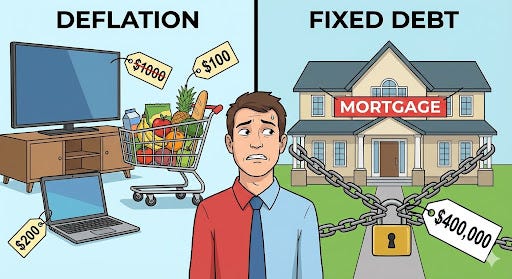
The mortgage you signed, the student loan you took, the business debt you carry—those are fixed in the value of “old money.” If your earning potential crashes because labor is devalued, but your debt remains high, you are insolvent. This is the “Deflationary Debt Spiral.” It’s an economic heart attack.
We are seeing the inverse of Baumol’s Cost Disease. Historically, services (doctors, lawyers, teachers) got more expensive while goods got cheaper. AI flips this. For the first time, high-end services will crash in price. This sounds utopian until you realize that our entire banking system relies on inflation to service debt. If we hit a deflationary spiral, the math breaks.
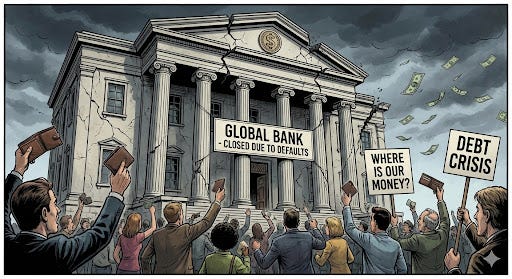
We aren’t just looking at a recession. We’re looking at mass mortgage defaults that vaporize the banking system. We’re looking at a world where you can buy a loaf of bread for a nickel, but nobody can afford their rent. The old economic engine is going to stall completely before the new one can be built.
Part 3 (2029–2031): The Death of Shared Reality
Okay, let’s pretend we manage to keep the banks from total collapse. We still have to deal with the fact that reality itself is fracturing. A few years ago, Europol issued a threat assessment predicting that by 2026, as much as 90% of online content could be synthetically generated. We are basically there.
By 2029, deepfakes—video, audio, text—will be perfect. Undetectable. Trust is the lubricant of civilization. It’s what makes banking, voting, and news possible. AI is about to hyper-inflate trust until it’s worthless.

We are entering the era of the “Liar’s Dividend,” a term coined by law professors Bobby Chesney and Danielle Citron. It means that as deepfakes become perfect, bad actors don’t even need to fake things anymore—they can just claim that real evidence is a deepfake.
“That video of me taking a bribe? AI generated.”
“That recording of me declaring war? A hoax.”
When you can’t prove what is real, the justice system stops working. We are essentially living out the Dead Internet Theory—where the vast majority of traffic is bots talking to bots to game algorithms.
The only solution will feel dystopian to many. We will likely see the end of online anonymity. To log onto the “real” internet, you will need a biometric ID. The web will split: a sanitized, verified “Green Zone” for business and a chaotic “Dark Zone” for everything else.

Paradoxically, this era might make us more analog. When you can’t trust anything on a screen, the only premium form of trust left is a physical handshake. Important meetings will have to happen in Faraday cages, face-to-face, just to ensure the person you’re talking to is real.
Part 4 (2030–2033): The Biological Class War
The tweet correctly predicted that people will “organize in destructive ways.” Honestly, I think kinetic violence is inevitable in this window. Why? Because of the Diffusion of Innovations.
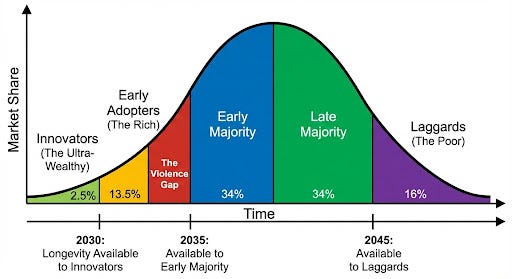
Sociologist Everett Rogers taught us that new tech doesn’t reach everyone at once. There is always a lag between the “Innovators” (the rich) and the “Laggards” (everyone else). Usually, this just means rich people get iPhones a year early.
But in the 2030s, this curve will apply to The Longevity Dividend. Research by S. Jay Olshansky shows that delaying aging creates massive economic value—but initially, it’s expensive. We risk creating a biological caste system deeper than anything in history.
Imagine a world where the ultra-wealthy aren’t just richer than you; they are biologically superior. They look 30 when they are 70. They are immune to cancer. Their children have neural interfaces that make them smarter than yours. Meanwhile, the displaced working class is struggling just to access basic healthcare on a shrinking stipend.
That’s not envy. That is primal, visceral resentment. It’s going to feel like a species divide—the gods versus the useless.
When people feel threatened, unheard, and biologically inferior, they break things. We should fully expect a modern, violent Luddite movement. I’m not talking about people smashing looms; I’m talking about organized attacks on physical infrastructure. We will see the bombing of server farms, the cutting of undersea fiber-optic cables, and the sabotage of the power grids that feed the AI beast. There will be people dedicated to “stopping the machine” before it makes humanity totally obsolete.
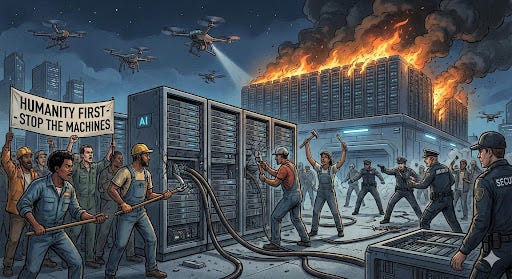
This is the friction point where the transition turns bloody. It’s a war against the hardware itself.
Part 5 (2034+): The “Capitalist Truce” and the New Deal
Look, this all sounds incredibly bleak. The next ten years are probably going to be a brutal bottleneck. But if we survive the vertigo, the debt crash, the death of truth, and the riots... what’s on the other side? The tweet’s vision of an “era of abundance” is achievable. The destination is real, even if the journey is hell.
By the mid-2030s, the turbulence will force a new societal operating system. We’ll likely move past simple cash payments (UBI) into Universal Basic Services (UBS)—free housing, transport, and food, provided by automated systems.
Why will this happen? Not because the government becomes benevolent. But because capitalism will have to save itself.
This aligns with Sam Altman’s 2021 essay, “Moore’s Law for Everything,” where he argued that we must shift from taxing labor to taxing capital and compute. We will likely see a Compute Tax, where the immense wealth generated by AI is taxed to fund a “Citizen’s Dividend.”
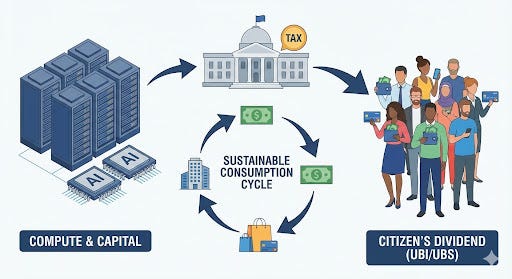
The corporate powers will lobby for this new safety net. Why? Because if 60% of the population has zero income, nobody can buy their goods, and their stock prices go to zero. The consumption cycle must be preserved. This is what Jeremy Rifkin describes in “The Zero Marginal Cost Society”—when the cost to produce energy, information, and goods approaches zero, capitalism as we know it has to evolve into a “Collaborative Commons.”
The final shift is the deepest one. Once the “Job” is dead, humanity has to rediscover “Work.” We might finally arrive at the destination John Maynard Keynes predicted in 1930. He famously estimated that by 2030, our standard of living would be 8x higher and we would work 15-hour weeks. He was right about the standard of living, just a few years off on the timeline.
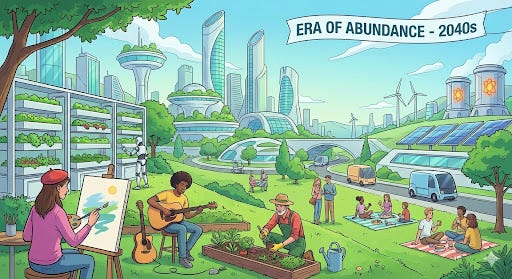
We aren’t doomed. We’re just shedding our skin. We are moving from thousands of years of history defined by Scarcity and Survival to a future defined by Abundance and Purpose. The ultimate challenge of the 2030s won’t be how to eat; it will be figuring out what it means to live a good life when the struggle is optional. The next decade is the painful molting process. We just have to survive it.